Counter (8-bit)

Counter (8-bit)

Counters signal_cellular_alt_2_bar Intermediate schedule 25 min

8-bit Counter

Overview

  • Purpose: The 8-bit Counter is a sequential digital circuit that progresses through a sequence of 256 distinct states (0 to 255) upon the application of clock pulses. It counts upward and can hold its current value or be cleared based on control signals.
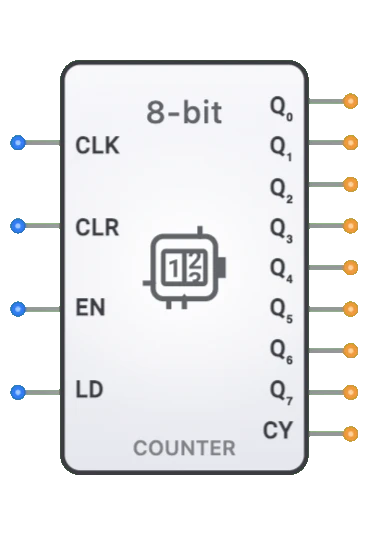
  • Symbol: The 8-bit Counter is represented by a rectangular block with inputs for clock (CLK), clear (CLR), enable (EN), and load (LD), with eight data outputs representing the current count value and a carry output.
  • DigiSim.io Role: Serves as an essential component for implementing timing, sequencing, and counting functions in digital systems, providing a wider range (256 states) than smaller counters for applications requiring more counting states.

counter 8uit component

Functional Description

Logic Behavior

The 8-bit Counter increments through a binary sequence on each rising clock edge when enabled. It counts upward only. When cleared, the counter returns to zero asynchronously regardless of the clock.

Operation Table:

CLR EN CLK Operation Output Effect
1 X X Clear (async) Q = 0
0 1 Count up Q[n+1] = Q[n] + 1
0 0 Hold Q[n+1] = Q[n]
0 X 0 No change Q[n+1] = Q[n]

Note: ↑ represents a rising clock edge, X represents a "don't care" condition. The counter wraps from 255 to 0.

Inputs and Outputs

  • Inputs:

    • CLK (Clock): Pin 0. Triggers the counter on the rising edge.
    • CLR (Clear): Pin 1. Asynchronously resets the counter to 0 when HIGH.
    • EN (Enable): Pin 2. Enables counting when HIGH.
    • LD (Load): Pin 3. Reserved for future use (parallel load not currently supported).
  • Outputs:

    • Q[7:0]: 8-bit output representing the current count value (Q0=LSB, Q7=MSB).
    • Carry: 1-bit output that goes HIGH when the counter reaches its maximum value (255).

Configurable Parameters

  • Clock Edge Sensitivity: Whether the counter responds to rising or falling clock edges.
  • Reset Type: Whether the reset is synchronous (only on clock edges) or asynchronous (immediate).
  • Reset Value: The value the counter resets to (typically zero).
  • Count Sequence: Whether the counter follows a binary, BCD, or other counting sequence.
  • Propagation Delay: The time it takes for outputs to change after a triggering event.

Visual Representation in DigiSim.io

The 8-bit Counter is displayed as a rectangular block with labeled inputs on the left side (CLK, RST, EN, UP/DOWN) and outputs (Q[7:0], COUT) on the right side. The clock input is typically marked with a triangle symbol indicating edge sensitivity. When connected in a circuit, the component visually indicates its current state through the binary value shown on its outputs and color changes on connecting wires.

Educational Value

Key Concepts

  • Sequential Logic: Demonstrates how digital circuits maintain and update state over time.
  • Binary Counting: Illustrates the progression through binary number sequences.
  • Synchronous Operation: Shows how clock signals coordinate and synchronize digital operations.
  • Modular Arithmetic: Presents the concept of rollover/wraparound when a counter exceeds its range.
  • Control Logic: Introduces the use of enable and direction controls to modify circuit behavior.

Learning Objectives

  • Understand how counters progress through binary sequences and maintain state.
  • Learn how control signals like reset, enable, and direction affect counter operation.
  • Recognize the difference between synchronous and asynchronous counter designs.
  • Apply 8-bit counters in designing timers, sequencers, and address generators.
  • Comprehend the concept of counter overflow/underflow and how carry outputs signal these conditions.

Usage Examples/Scenarios

  • Address Generation: Sequentially accessing memory locations in a CPU or controller.
  • Timer Implementation: Creating precise time delays or measuring time intervals.
  • Event Counting: Tallying occurrences of events or pulses in digital systems.
  • Frequency Division: Dividing an input clock frequency by a programmable factor.
  • State Sequencing: Implementing the sequencing logic for finite state machines.
  • Data Acquisition: Controlling the timing for sampling analog signals.
  • Digital Control Systems: Generating timing sequences for control operations.

Technical Notes

  • The 8-bit counter can be implemented using various architectures:
    • Asynchronous (Ripple) Counter: Simple but has propagation delay issues across bit positions.
    • Synchronous Counter: All flip-flops change simultaneously, providing more reliable timing.
  • An 8-bit binary counter can represent values from 0 to 255 before rolling over.
  • The maximum operating frequency is limited by the propagation delay through the counter's logic.
  • Counters can be cascaded to create wider counters (16-bit, 32-bit) by connecting the carry output of one counter to the enable of the next.
  • Special counter configurations like Johnson counters or ring counters provide different counting sequences for specific applications.
  • In DigiSim.io, the counter's behavior simulates real-world digital components with proper handling of control inputs and synchronous operation.

Characteristics

  • Input Configuration:

    • Clock input (CLK): Triggers state transitions, typically active on rising edge
    • Reset input (RST): Asynchronously resets counter to zero when asserted
    • Enable input (EN): Enables or disables counting operation
    • Direction control (UP/DOWN): Determines count direction (up when high, down when low)
    • Compatible with standard digital logic levels
    • May include additional inputs in some implementations (load, preset, etc.)
    • Typical clock frequency range: DC to 50+ MHz depending on technology
  • Output Configuration:

    • Eight state outputs (Q0-Q7)
    • Carry/borrow output (Cout) - asserted when counter overflows (up) or underflows (down)
    • Each output represents one bit of the current count value
    • Q0 is the least significant bit (LSB), Q7 is the most significant bit (MSB)
    • Capable of driving standard digital loads
    • May include complementary outputs in some implementations
  • Functionality:

    • Counts through binary sequence from 0 to 255 (or 255 to 0)
    • Full 8-bit range provides 256 distinct states
    • Wraps around from 255 to 0 when counting up
    • Wraps around from 0 to 255 when counting down
    • Carry output generated on wrap-around conditions
    • Can be configured for different counting sequences
    • Modulo-N counting possible with additional logic
  • Propagation Delay:

    • Clock-to-output: 15-35ns typical
    • Setup time: 10-20ns before clock edge
    • Hold time: 0-10ns after clock edge
    • Reset-to-output: 10-25ns
    • Technology dependent (TTL, CMOS, etc.)
    • Synchronous designs have consistent output timing
    • Higher delays in cascaded asynchronous implementations
  • Fan-Out:

    • Typically drives 10-20 standard loads
    • Output loading affects propagation delay
    • May require buffering for high fan-out applications
    • Modern CMOS implementations have improved drive capability
  • Power Consumption:

    • Static power minimal in CMOS implementations
    • Dynamic power increases with clock frequency
    • Proportional to number of bits that change state
    • Higher than 4-bit counters due to additional flip-flops
    • Power management features in many implementations
    • Can be significant in high-speed applications
  • Circuit Complexity:

    • Moderate to high complexity
    • Requires eight flip-flops plus control logic
    • Synchronous designs more complex than asynchronous
    • Additional logic for features like parallel load
    • Complexity increases with feature set
    • Integrated versions reduce external component count

Implementation Methods

  1. Asynchronous (Ripple) Counter

    • Cascade of eight flip-flops (typically T or JK type)
    • Each flip-flop output drives the clock of the next
    • Simple implementation but with propagation delay issues
    • The LSB changes on every clock, higher bits change when driven
    • Not suitable for high-speed applications
    • Glitches can occur during transitions
    • The simplest design but with timing limitations
  2. Synchronous Counter

    • All flip-flops share a common clock
    • State transitions occur simultaneously
    • Additional combinational logic determines which flip-flops toggle
    • More complex than ripple design but with better timing
    • Higher speed operation than asynchronous designs
    • Predictable timing behavior
    • Can be implemented with D, JK, or T flip-flops
  3. Up/Down Binary Counter

    • Bidirectional counting capability
    • Direction control logic for each flip-flop
    • Additional complexity for direction control
    • Common in application-specific counters
    • Synchronous implementation preferred for reliable operation
    • Carry/borrow logic for both counting directions
  4. Presettable Counter

    • Includes parallel load capability
    • Data inputs for each bit
    • Load enable control signal
    • Can be initialized to any value
    • Useful for timing specific intervals
    • Additional multiplexers for load path
    • Common in programmable timer applications
  5. Binary Coded Decimal (BCD) Counter

    • Modified 8-bit counter with two BCD decades
    • Counts from 0 to 99 in decimal
    • Reset logic for each 4-bit section at count 10
    • Useful for human-readable counting applications
    • Common in displays and user interfaces
    • More complex decoding logic
  6. Integrated Circuit Implementation

    • Available as dedicated counter ICs
    • Common in 74xx series (74LS590, 74HC590, 74HC393 cascaded)
    • Various features: presettable, cascadable, up/down
    • Different technologies for various speed/power requirements
    • May include additional features like tri-state outputs
    • Reduces component count in system designs
  7. FPGA/ASIC Implementation

    • Efficient implementation using flip-flops and LUTs
    • Highly configurable and optimizable
    • Easy to add specialized features
    • Often synthesized from HDL descriptions
    • Resource-efficient in modern programmable logic
    • Can be tailored for specific timing requirements

Applications

  1. Memory Addressing

    • Program counter in microcontrollers and CPUs
    • Address generation for sequential memory access
    • DRAM refresh counters
    • Stack pointers in computing systems
    • DMA controllers for memory transfers
    • Sequencing through memory locations
  2. Timing Generation

    • Precision timing intervals (up to 256 clock cycles)
    • Programmable delay generation
    • Pulse width control
    • System timing coordination
    • Real-time clock subsystems
    • Timeout generation
  3. Frequency Division

    • Clock dividers with division ratios up to 256
    • Precision frequency synthesis
    • Signal generators
    • Baud rate generators for communication
    • Clock management in digital systems
    • Frequency scaling
  4. Event Counting

    • High-range event tallying
    • Pulse counting in instrumentation
    • Revolution counting
    • Flow measurement
    • Occurrence rate monitoring
    • Production line counting
  5. Digital Control Systems

    • State machine implementation
    • Sequencing control operations
    • Motor control timing
    • Process controllers
    • Industrial automation sequencing
    • Time-based control algorithms
  6. Data Acquisition

    • Sample timing control
    • ADC control sequencing
    • Data buffering addresses
    • Measurement trigger generation
    • Sampling rate control
    • Averaging counter for noise reduction
  7. Communication Systems

    • Frame counter for data packets
    • Byte sequencing in serial protocols
    • Communication timing
    • Protocol sequencing
    • Error detection counters
    • Bit timing generators

Limitations

  1. Timing Constraints

    • Maximum operating frequency limited by technology
    • Setup and hold time requirements for reliable operation
    • Clock skew concerns in complex systems
    • Propagation delay accumulation in asynchronous designs
    • Reset recovery timing requirements
    • Inconsistent timing across all bits in ripple implementations
  2. Glitches and Race Conditions

    • Output glitches during transitions (especially in asynchronous designs)
    • Intermediate states during multi-bit transitions
    • Critical in control applications
    • Potential false triggering of downstream logic
    • Hazards in output decoding logic
    • Race conditions in counter feedback paths
  3. Range Limitations

    • Limited to 8-bit values (0-255)
    • Requires cascading for larger counting ranges
    • Overflow handling for counts exceeding range
    • Extra logic needed for non-binary sequences
    • Modulo-N counting requires additional logic
    • Inefficient for small counting ranges
  4. Power Consumption

    • High dynamic power at fast clock rates
    • Power spikes during multiple bit transitions
    • Significant in battery-powered applications
    • Increases with switching frequency
    • Higher than smaller counters due to more flip-flops
    • Thermal considerations in high-speed operations
  5. Design Complexity

    • More complex than smaller counters
    • Advanced features increase logic requirements
    • Synchronous designs require more combinational logic
    • Testing and verification complexity
    • Increased component count or logic resources
    • Complex timing analysis for critical applications

Circuit Implementation Detail

8-bit Synchronous Binary Up Counter

graph TB
    Clock[Clock CLK] --> FlipFlop0[Flip-Flop 0]
    Clock --> FlipFlop1[Flip-Flop 1]
    Clock --> FlipFlop2[Flip-Flop 2]
    Clock --> DOTS[...]
    Clock --> FlipFlop7[Flip-Flop 7]
    
    Reset[Reset RST] --> FlipFlop0
    Reset --> FlipFlop1
    Reset --> FlipFlop2
    Reset --> DOTS
    Reset --> FlipFlop7
    
    FlipFlop0 --> OutputQ0[Q0]
    FlipFlop1 --> OutputQ1[Q1]
    FlipFlop2 --> OutputQ2[Q2]
    DOTS --> QDOTS[...]
    FlipFlop7 --> OutputQ7[Q7]
    
    ControlLogic[Enable & Clock<br/>Control Logic]
    Enable[Enable EN] --> ControlLogic
    UpDown[UP/DOWN] --> ControlLogic
    ControlLogic -.-> FlipFlop0
    ControlLogic -.-> FlipFlop1
    ControlLogic -.-> FlipFlop2
    ControlLogic -.-> FlipFlop7

74HC590 8-bit Binary Counter with Output Register

    ┌─────────────────┐
    │                 │
    │     74HC590     │
    │                 │
CLK ┤CP            Q0 ├── Q0
    │                 │
MR  ┤MR            Q1 ├── Q1
    │                 │
    │               Q2 ├── Q2
    │                 │
    │               Q3 ├── Q3
    │                 │
    │               Q4 ├── Q4
    │                 │
    │               Q5 ├── Q5
    │                 │
    │               Q6 ├── Q6
    │                 │
    │               Q7 ├── Q7
    │                 │
CEP ┤CEP              │
    │                 │
CET ┤CET          Q7S ├── Cout
    │                 │
OE  ┤OE               │
    │                 │
RCK ┤RCK              │
    │                 │
    └─────────────────┘

CP = Clock Pulse input, MR = Master Reset, CEP/CET = Count Enable inputs, OE = Output Enable, RCK = Register Clock, Q7S = Carry output

Related Components

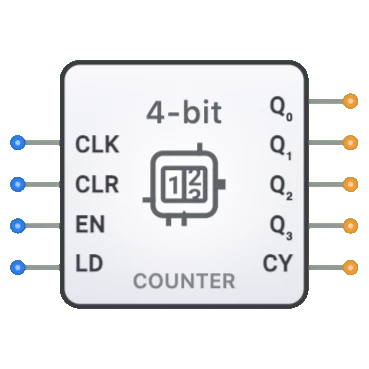
  • 4-bit Counter: Smaller counter with range 0-15
  • 16-bit Counter: Extended counter with range 0-65535
  • BCD Counter: Counts in decimal digit sequences
  • Up/Down Counter: Bidirectional counter with direction control
  • Loadable Counter: Counter with parallel data loading capability
  • Johnson Counter: Shift register with inverted feedback, with one bit change per state
  • Ring Counter: Shift register with direct feedback, circulating a single bit
  • Cascaded Counter: Multiple counters connected to extend counting range
  • Frequency Divider: Counter used specifically for clock division
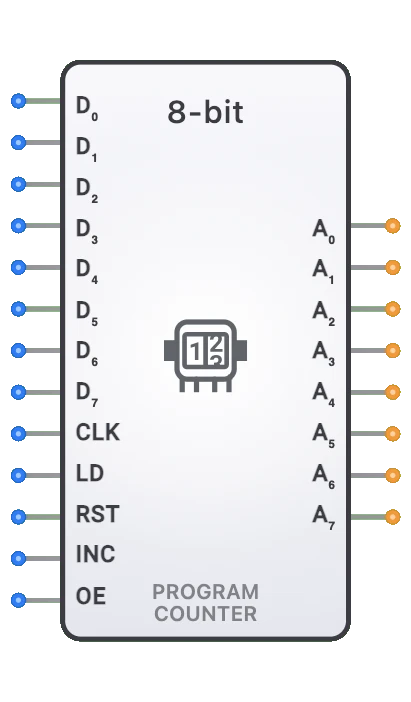
  • Program Counter: Specialized counter for instruction sequencing in processors

school 学习路径

arrow_back 前置知识

arrow_forward 下一步

help_outline 常见问题

What is the range of an 8-bit counter?

An 8-bit counter counts from 0 to 255 (decimal) or 00000000 to 11111111 (binary), providing 256 unique states.

play_arrow 运行在线电路

查看其他组件